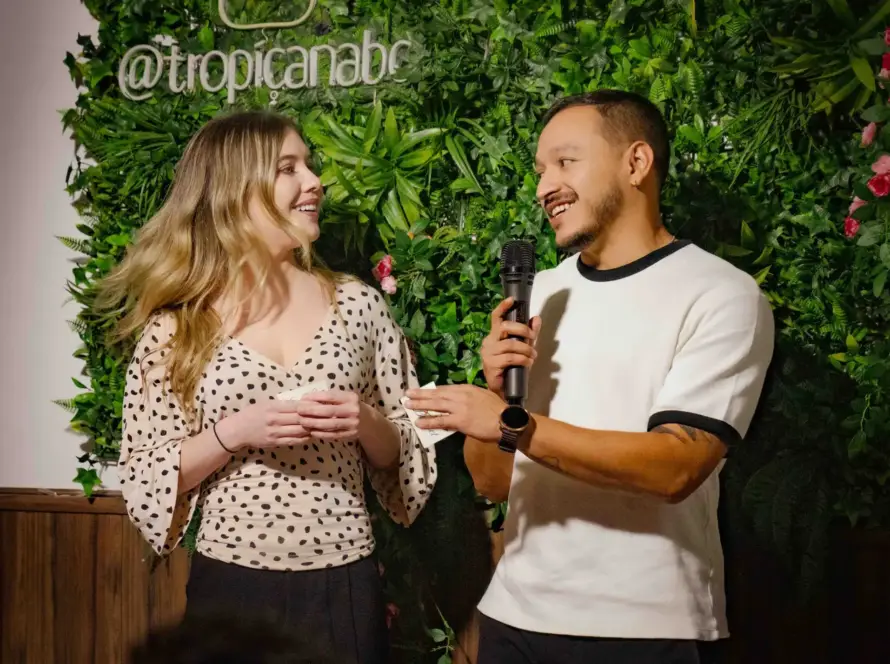


Ask people whether stand-up comedy is an art form and plenty of them hesitate. It happens in bars. Nobody wears a costume. Half the audience is holding a drink. But watch a good comedian hold a room for an hour and the craft is hard to miss: the writing, the timing, the rewriting after every show, and the nerve to stand alone with a microphone and a point of view.
This article looks at stand-up comedy as an art form, where it sits in Madrid’s cultural life, and what we’ve learned from putting more than 70 comedians on stages across the city at the Madrid International Comedy Festival.
What makes stand-up comedy an art form
Stand-up has a few things that set it apart from the other performing arts. The comedian is usually the writer, the director and the performer at the same time. There’s no fourth wall: the audience is part of the show, and the same set plays differently depending on who is in the room. And the work is never really finished. Comedians test material in small rooms, keep what lands, cut what doesn’t and come back next week with a better version.
Steve Martin described his own career in exactly those terms. In his memoir Born Standing Up he wrote that he did stand-up for 18 years: ten spent learning, four refining and four in success (NPR, Fresh Air). Few comedians follow that timeline, but it shows how much work sits behind a set that looks effortless.
The other thing that makes it art is point of view. Two comedians can take the same subject, a breakup, a family dinner, a first week in a new country, and come out with two completely different hours. What people pay for is the way one person sees the world.
Spanish critics treat it that way too. When Louis C.K. played Madrid, the magazine Letras Libres reviewed the show as a piece of craft, spending most of the review on how he builds his material rather than on the jokes themselves.
How stand-up arrived in Spain
Spain has a long tradition of humour on stage, from café-teatro to the comic monologue. Stand-up as most people know it today took off in 1999. Paramount Comedy started broadcasting in Spain on 1 March that year, and its show Nuevos cómicos put unknown comedians on national television. That September, El Club de la Comedia premiered (Centro Virtual Cervantes).
Madrid was at the centre from the start. When Paramount Comedy went looking for comedians, it searched the city’s small live circuit (Merca2). La Chocita del Loro opened in Carabanchel in 1998 and later added a venue on Gran Vía. Teatro Alfil in Malasaña, run by the company Yllana since the 1990s, became a home for comic theatre and stand-up (Yllana).
The next generation came through radio, television and podcasts. La Vida Moderna, with David Broncano, Quequé and Ignatius Farray, ran on Cadena SER from 2014 to 2022 and won a Premio Ondas in 2018. La Resistencia was recorded in Madrid theatres from 2018 to 2024 (Wikipedia). For the longer story of the city’s scene, read how Madrid became one of Europe’s most exciting cities for live comedy, and for what Spanish audiences actually laugh at, see Spanish humour explained.
Madrid is Spain’s capital of live performance
The numbers back up what comedians already feel. According to the SGAE yearbook published in 2025, the Comunidad de Madrid (the whole region, not only the city) hosted 16,166 performing arts shows in 2024 and drew 3.98 million spectators. That’s 38.3% of all performing arts spectators in Spain and 49.2% of the country’s box office. In theatre alone, the region had 40.5% of Spain’s spectators (Anuario SGAE 2025).
The city’s audience is also unusually mixed. On 1 January 2026, 30.5% of the people registered in the city of Madrid, just over 1,065,000 of its 3.5 million residents, were born outside Spain (Ayuntamiento de Madrid). For comedy that matters. A big part of the audience grew up laughing at different things, in different languages.

Stand-up is still invisible in the statistics
Here’s the strange part. For all its popularity, stand-up has no category of its own in Spain’s cultural data. The SGAE yearbook splits the performing arts into theatre, dance and lyric arts. The Ministry of Culture’s survey of cultural habits asks about theatre, dance, opera, zarzuela and circus. Comedy shows end up counted as theatre, or not counted at all when they happen in the back room of a bar.
The survey still gives useful context. In 2024-2025, 47.1% of people in Spain went to at least one live performance in the previous year, and 24.7% went to the theatre (Ministerio de Cultura). How many of those nights were comedy, nobody can say.
That gap has consequences. A sector that can’t be measured is harder to plan for and harder to protect, which is part of why we think Madrid needs more comedy venues.
Recognition is catching up
There are signs that’s changing. In 2024 SGAE created the Premio SGAE de Humor Miguel Gila, an award for stand-up and comic monologue shows. Goyo Jiménez won the first edition. The 2025 awards, announced in January 2026, went to Leo Harlem (honorary award), Manu Sánchez for Entregamos (best monologue show) and Javier Corral (newcomer) (Fundación SGAE).
Treating a comedy hour as an authored work, the way you’d treat a play or a song, is simply recognising what it is.
What a festival adds
A festival is where the craft becomes visible all at once. At the Madrid International Comedy Festival every show is performed in the language it was written in. In 2026 that meant 38 shows over four days, with more than 70 comedians from more than 20 countries, in eight languages, across nine venues in central Madrid. You can see the whole programme on the 2026 shows page.
It’s also where you see how wide stand-up can be. Joseph Ewonde Jr. won Best Special at the MICF Awards for Pata Negra, an hour in Spanish built around a song a stranger once sang at him in the street. Iain Anderson performed Traumedy, his true story from the Glasgow gay scene to homelessness in Barcelona and, in the end, recovery. Hassan Elfadul, who won Best Act, talks about growing up in Sudan in a way that makes a room laugh with him, not at him. Three very different hours, and all of them art in the plainest sense: one person turning a life into something a room full of strangers can feel.
That’s what we want to add to Madrid’s cultural life: a few days every October when stand-up is the main event, not the thing that happens after dinner. It’s a big reason the festival has become one of the largest international stand-up festivals in Spain, as we explain in our piece on comedy festivals in Spain, and why we believe it can become one of Europe’s best.
FAQ
Is stand-up comedy an art form?
Yes. A stand-up comedian writes, directs and performs their own work, and keeps rewriting it in front of live audiences. In Spain, SGAE now gives a dedicated award to stand-up and comic monologue shows, the Premio SGAE de Humor Miguel Gila.
When did stand-up start in Spain?
Comic monologues on stage are much older, but stand-up as a format took off in 1999, when Paramount Comedy launched in Spain and El Club de la Comedia premiered on television.
Is stand-up counted in Spain’s cultural statistics?
Not separately. Official surveys and the SGAE yearbook count comedy inside theatre, so there is no official figure for comedy audiences alone.
Where can I see stand-up comedy in Madrid?
All year, in comedy bars and small theatres. Our guide to stand-up comedy in Madrid covers where to go. Every October, the Madrid International Comedy Festival brings comedians from more than 20 countries to the city.
The Madrid International Comedy Festival 2027 runs from 6 to 10 October 2027. The programme and tickets will be announced in June 2027. Join the list to hear first and get early tickets.
For how the art form took root here, read our short history of stand-up comedy in Spain.