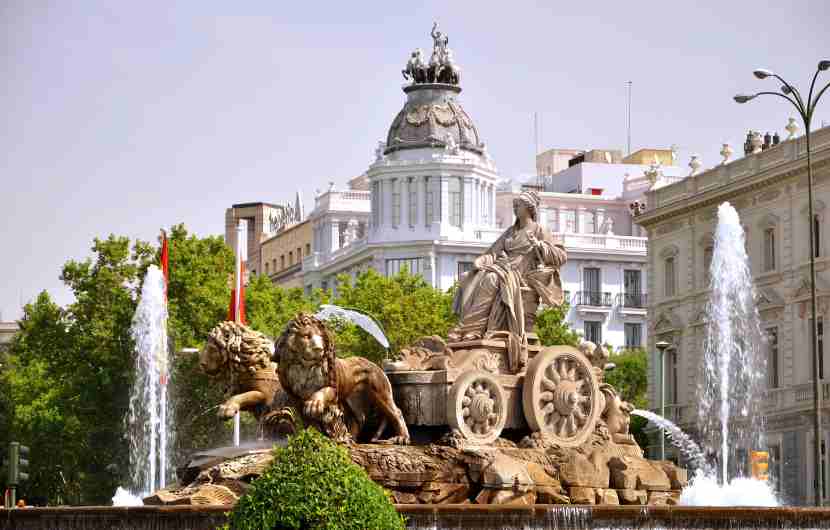


Madrid has no coastline, no river worth the name and very little in the way of hills. What it has instead is roofs — and a long-standing habit of climbing onto them. The azotea, the flat rooftop terrace, is where the city goes to escape the heat, watch the light change and drink something cold above the traffic.
Why Madrid took to its roofs
Sit at 650 metres above sea level on a dry inland plateau and summer evenings cool down fast once the sun drops. Madrid’s roofs catch whatever breeze there is, and the city’s low, even skyline means even a modest six-storey building gives you a genuine view. There’s no wall of towers blocking the horizon — the tall buildings are clustered well to the north, out of the way.
The result is that rooftop bars here aren’t a novelty imported from somewhere else. They’re an extension of an old habit, and they range from polished hotel terraces to scruffy neighbourhood spots with plastic chairs.
The landmark rooftops
A few are institutions. The roof terrace at the Circulo de Bellas Artes on Calle de Alcala is probably the best-known viewpoint in central Madrid, looking straight down the avenue towards the Metropolis building. The Palacio de Cibeles, the extraordinary early twentieth-century building that now houses the city council, also opens an upper terrace with views across the Paseo del Prado.
Both charge for access and both change their arrangements seasonally, so check current details before making the trip. The same applies to the department store and hotel terraces around Callao and Plaza de Espana, several of which look directly over Gran Via.
The unglamorous alternative
The landmark terraces are worth doing once. After that, the better experience is usually a neighbourhood rooftop with no view to speak of and no queue. Plenty of ordinary bars in Malasana, La Latina and Lavapies have a small terrace upstairs that regulars treat as an extension of the living room. You won’t get a skyline. You’ll get a seat, a reasonable bill and a much better sense of how the city actually spends its evenings.
Timing it right
- Aim for the hour before sunset. Madrid’s light in the last half hour of the day is the reason people come up here.
- Book the well-known terraces ahead in summer. Turning up on spec at 9pm in July rarely works.
- Bring a layer. The temperature drop after dark is sharper than visitors expect, especially in spring and autumn.
- Roof terraces are among the first things to close in bad weather, so have a ground-floor backup.
October is arguably the best month for this. The heat has broken, the terraces are still open, and the evenings are long enough to sit outside comfortably — see our guide to Madrid in October.
Where the evening goes next
A rooftop is a starting point, not a whole night. Madrid eats late and goes out later, so the terrace tends to be the drink before dinner rather than the destination. Our nightlife guide and our list of things to do after dark cover what comes afterwards — including live comedy, which runs most nights across the centre. During the Madrid Comedy Festival in early October, a sunset terrace followed by a show is about as good as a Madrid evening gets.
Frequently asked questions
Do Madrid rooftop bars have a dress code?
Hotel terraces sometimes do; neighbourhood ones never do. Smart casual covers you almost everywhere. Madrid dresses up slightly more than most northern European cities for a night out, but rarely formally.
Are rooftop terraces open in winter?
Some close entirely from around November; others stay open with heaters and covers. Season dates vary year to year, so check directly with the venue rather than assuming.
Is there a free rooftop view in Madrid?
Not many, but you don’t need one. The Templo de Debod gives you an open western view at sunset for nothing, and it’s one of the best vantage points in the city — see our guide to free things to do in Madrid.